Honey Bee Life Simulator 3D
Games AstraAdventure
0.00.00 Reviews
- Version
- 0.7
- Installs
- 100.00K
- Age Rating
- Everyone
Screenshots
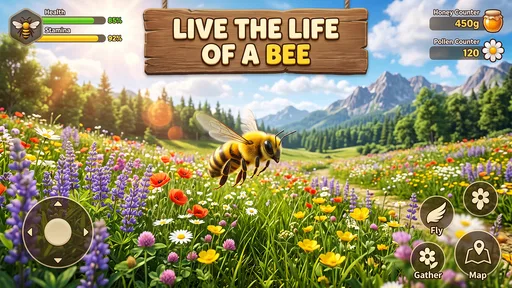
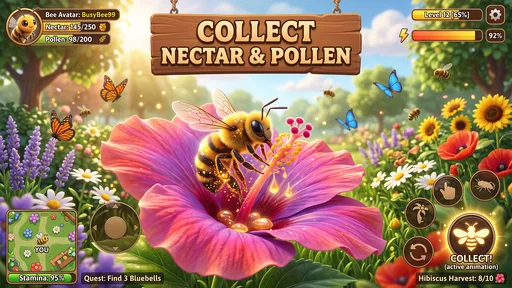
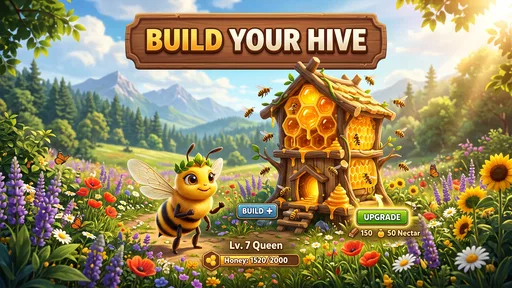
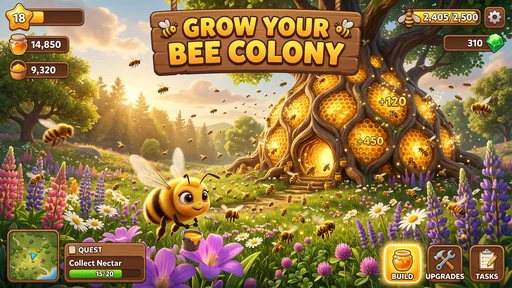
Our Review of Honey Bee Life Simulator 3D
 Analysis by Appyee
Honey Bee Life Simulator 3D is the kind of adventure game I open when I want something gentler than a combat-focused mobile game. Instead of sending me through battles or demanding fast reactions, it puts me in the role of a honey bee and builds its appeal around exploring a hive, gathering nectar, and helping a colony grow. My overall impression is that it works best as a relaxed, accessible miniature-world experience rather than as a deep simulation for players who want complex systems.
That distinction matters. The game has a clear theme and an easy-to-understand loop, but its enjoyment depends heavily on whether you like repeating small tasks in a colorful setting. I found the bee perspective more interesting than the usual animal or farming setup, especially when I treated each trip away from the hive as a short expedition instead of expecting a large adventure campaign. Its strongest quality is the way it turns ordinary bee behavior into a simple, approachable game routine.
What the bee-life adventure feels like in practice
From the first sessions, the main rhythm is easy to grasp: move through the environment, look for nectar, return to the hive, and use what you have collected to support the colony. That structure gives the game a pleasant sense of purpose. I am not wandering without a reason, but I am also not buried under complicated instructions or a long list of objectives.
The hive acts as more than a backdrop. It gives the adventure a home base and makes each outing feel connected to a larger goal. When I played with that mindset, the repeated collecting became more satisfying because I was thinking about progress for the colony rather than treating every trip as an isolated chore. Players who enjoy gradual improvement should understand the appeal quickly.
The exploration angle is also important. This is not simply a collection screen disguised as a bee game. The pleasure comes from moving through the world at a smaller scale and seeing familiar surroundings from an insect’s point of view. That change in perspective gives otherwise ordinary routes a little more character. I enjoyed paying attention to where I was going instead of rushing through every activity.
At the same time, I would not describe the experience as a detailed biological simulation. The title suggests a 3D life simulator, but the practical appeal is closer to a casual adventure with resource gathering and colony-building themes. That is not a criticism by itself; it simply sets the right expectation. Someone looking for a calm game with a clear loop will probably be happier than someone expecting realistic bee behavior or a highly technical management system.
A useful routine for short play sessions
One of the better ways to approach the game is to divide play into small objectives. I might begin by deciding that the next outing is only about collecting enough nectar for a particular improvement, then return to the hive and stop once that goal is complete. This keeps the repetition from feeling endless and makes the game fit naturally into a short break.
That routine is especially useful on a phone. I do not need to remember a complicated chain of missions before returning later. The central activity remains obvious, and the peaceful pace makes it suitable for players who do not want constant pressure. It also gives younger players a straightforward way to understand cause and effect: explore, gather, bring resources home, and see the colony move forward.
A less obvious benefit is that the bee theme encourages careful movement. I found myself scanning the environment for useful places instead of following the fastest possible route. That makes the game feel more exploratory than a basic resource counter. My advice is to resist treating every trip as a race. The setting has more value when I take time to look around and learn the space.
Where the colony-building idea works best
The colony gives the collecting loop a stronger emotional reason than gathering items simply to fill a meter. Even without turning the game into a complex strategy title, the idea of bringing resources back to a shared home makes progress feel communal. I prefer that framing to games where every upgrade exists only to unlock another upgrade.
It also makes the game approachable for families. The Everyone content rating fits the gentle premise, and the focus on bees, nectar, and a hive is easy to explain without relying on mature themes. I could see it working as a casual game for a child who likes animals, provided an adult is comfortable with the way the game handles optional purchases.
There is a practical lesson here for new players: do not spend resources impulsively just because an option becomes available. I got more enjoyment from establishing a steady gathering routine first, then deciding which progress mattered most. That approach reduces the feeling that I am simply tapping through the next available prompt and gives the colony-building side a little more intention.
The main weakness is repetition, not difficulty
The biggest limitation is that the central loop can become predictable. Exploring, collecting, and returning to the hive is pleasant at first, but it needs enough variation to stay compelling over longer sessions. I noticed that the game is more enjoyable in measured visits than in extended marathons. After repeating the same type of outing several times, the sense of discovery naturally weakens.
This is where the game differs from larger adventure alternatives. A conventional adventure game may offer combat, puzzles, character stories, or changing mission types to keep the player moving forward. A farming game may provide broader customization and more elaborate long-term planning. Honey Bee Life Simulator 3D is narrower by design. Its focus is appealing, but that focus also limits how much variety I can expect.
Players should also be aware that the free entry point does not mean every part of the experience is necessarily free of spending pressure. Optional in-app items are listed at prices ranging from $14.99 to $19.99 per item, which is a meaningful consideration for families and anyone trying to keep mobile gaming completely cost-free. I would recommend checking purchase settings before handing the device to a child, and I would avoid assuming that an attractive upgrade is automatically worth paying for.
The game is free to start, and that makes it easy to try without committing immediately. Still, the presence of relatively expensive individual items changes how I evaluate the experience. I would play the free portion first, decide whether the basic loop genuinely holds my attention, and only then consider whether any optional purchase adds enough value. For me, the game needs to remain enjoyable without spending before it becomes a good recommendation.
Controls, pacing, and the right expectations
The accessible premise suggests a low barrier to entry, but the real test is whether the movement and interaction feel comfortable on a phone. I found that slower, deliberate play suits the concept better than trying to control the bee with urgency. If I approached it like a fast action game, the relaxed design felt less satisfying; when I accepted the slower pace, the experience made more sense.
That pacing may be a strength for some players and a weakness for others. It is useful when I want a quiet distraction after work or during a short rest. It is less suitable when I want immediate challenge, sharp competition, or a constant stream of new objectives. The game does not need to become frantic to be good, but it does need to be judged as a calm adventure rather than an adrenaline-driven one.
Another practical point is device compatibility. The current version is 0.7, and it supports devices running Android 7.0 or later. That gives the game a reasonably broad starting point for Android users, although the experience can still depend on the phone itself. On an older device, I would close unnecessary background apps and avoid judging the game only by a single short session if performance feels uneven.
The developer behind the game is Games Astra. Knowing that helps place the title in the context of a smaller, focused mobile experience rather than a major franchise release. I approached it expecting a compact concept built around one theme, and that expectation made the strengths easier to appreciate while keeping the limitations in perspective.
Who will get the most from it
I would recommend this game to players who enjoy animal-themed adventures, simple collecting, and gradual progress. It is particularly well suited to someone who likes the idea of exploring a world from an unusual perspective but does not want a complicated role-playing system. The hive provides a clear anchor, while the nectar-gathering routine gives each session an understandable purpose.
It can also suit parents looking for an Everyone-rated game with a nonviolent premise. I would still supervise purchases, especially because the optional items can cost $14.99 to $19.99 each. The age rating makes the theme broadly accessible, but it does not remove the need for sensible device and payment controls.
A realistic everyday use case is a ten-minute break between tasks. I can launch the game, make one focused trip, collect what I need, and return to the hive without having to dedicate an entire evening. That makes it more convenient than a story-heavy adventure that expects long uninterrupted sessions. The same quality may frustrate players who want a substantial narrative every time they play.
I would skip it if my priority were competitive multiplayer, deep colony management, realistic ecology, or a large variety of mission types. I would also look elsewhere if I quickly lose interest in repeated gathering. A traditional adventure game will probably offer more dramatic surprises, while a dedicated management game may provide more control over production, planning, and optimization.
How it compares with familiar alternatives
Compared with a typical farming game, this title has a more distinctive identity. The bee viewpoint gives the collecting routine a sense of scale and makes the environment feel different from a standard field or village. However, farming games often offer broader customization and a more developed schedule of activities, so they may be better for players who want many systems to manage.
Compared with a conventional animal simulator, the colony objective gives this game a stronger shared purpose. I am not only observing or controlling an animal; I am working toward the upkeep and growth of a hive. The trade-off is that the experience may feel less open-ended than a sandbox where I can freely experiment with many kinds of behavior.
Compared with a story-led adventure, the appeal here is immediate and uncomplicated. I do not need to follow a dramatic plot to understand what I should do next. The cost is narrative depth. If character development and surprising story turns are the main reasons I play, this bee-centered loop will probably feel too limited.
That comparison leads to my central judgement: the game succeeds when its simplicity is treated as the feature, not as a missing layer of complexity. I enjoyed it most when I wanted a small, peaceful activity with a clear theme. I enjoyed it least when I expected the world to keep introducing new forms of challenge.
My final recommendation
Honey Bee Life Simulator 3D is a pleasant, focused adventure for anyone attracted to the idea of living as a honey bee and supporting a hive through exploration and nectar gathering. Its concept is easy to understand, its age rating makes it broadly approachable, and its free starting point lowers the risk of trying it. With over 100K installs, it has also found an audience interested in this particular kind of mobile experience.
My recommendation comes with a clear condition: play it for the atmosphere and the steady routine, not for endless variety or deep simulation. The repetition is the main weakness, and the optional items priced from $14.99 to $19.99 deserve careful consideration before any purchase. I would begin with the free experience, set a personal spending limit, and use short sessions to see whether the gathering loop remains enjoyable.
For me, this is a modest but appealing game rather than a complete replacement for a larger adventure or management title. It is best for relaxed players, younger audiences with appropriate supervision, and anyone who likes turning a simple animal theme into a small daily ritual. If you want a calm bee adventure with a clear home-and-exploration cycle, it is worth trying; if you need constant novelty, choose a broader alternative instead.
Verdict
Strengths of Honey Bee Life Simulator 3D
- Relaxing gameplay with simple controls suitable for casual players.
- Bright 3D environments make exploring flowers and gardens enjoyable.
- Short play sessions work well for mobile gaming on the go.
- Collecting nectar gives each flight a clear and rewarding objective.
- Bee-themed gameplay offers a light, family-friendly experience.
Limitations of Honey Bee Life Simulator 3D
- Repetitive missions may become predictable after extended play.
- Some areas can feel empty while exploring the environment.
- Progression may feel slow without frequent gameplay sessions.
- Touch controls can be imprecise during fast aerial movement.
- The game may require considerable storage on older devices.
Similar Picks in This Category
View All
Roblox
Roblox Corporation4.2

Pokémon GO
Niantic, Inc.3.5

Ninja warrior: legend of adven
TOH Games4.6

Ninja Arashi
Black Panther4.6

Eyes - The Horror Game
Fearless Games sp. j.4.5

Critical Action:Gun Strike Ops
FPS Shooter & Action Game4.3
Frequently Asked Questions
What is Honey Bee Life Simulator 3D about?
Honey Bee Life Simulator 3D is a casual simulation game that lets you experience life as a busy honey bee. You typically explore colorful environments, collect nectar, search for flowers, complete simple objectives, and return to the hive. The game focuses on accessible controls, light exploration, and short gameplay sessions rather than complex strategy or realistic insect behavior.
How do you play Honey Bee Life Simulator 3D?
Gameplay generally involves guiding your bee around the environment, locating flowers or other resources, collecting nectar, and completing missions or tasks shown on screen. Virtual controls are designed for mobile play, so movement is easy to understand after a few minutes. As you progress, the objectives may become more demanding and encourage you to explore larger areas carefully.
Is Honey Bee Life Simulator 3D suitable for children?
The game is generally suitable for players who enjoy simple, non-violent simulation experiences, including many younger users. Its colorful presentation and straightforward objectives make it easy to approach. However, parents should still review the store listing, age rating, advertisements, and any in-app purchase information before installation, since these details can vary between Android and iOS versions.
Does Honey Bee Life Simulator 3D require an internet connection?
The core gameplay may work without a constant internet connection, which is useful when you want to play while traveling or away from Wi-Fi. Nevertheless, the application may need internet access for advertisements, analytics, updates, store features, or restoring purchases. Because offline availability can change after updates, it is best to test the game once after installation before relying on it without mobile data.
Is Honey Bee Life Simulator 3D free to download?
Honey Bee Life Simulator 3D is commonly offered as a free download, but the free version may include advertising or optional purchases. Ads can appear between activities or when receiving certain rewards, depending on the edition installed. Before downloading, check the official Google Play or App Store page for the current price, permissions, supported devices, purchase options, and latest update information.
Play our best games!


